
West HuntspillPrimary School
About Us
Safeguarding and Pastoral support
“Safeguarding the rights of others is the most noble and beautiful end of a human being”
Khalil Gibran
Our Designated Safeguarding Lead is
Laura Collins - Deputy Headteacher
Our Deputy Designated Safeguarding Leads are
Amanda Loach and Emma Barker
Samara Johnson - Little Learners
Our school is dedicated to looking after and safeguarding all of our children. Safeguarding covers children’s physical, social and emotional well-being and runs alongside our work on Health and Safety and E-safety.
The school has a Safeguarding Policy that is in line with recommendations from NSSCB. The policy is reviewed annually by the academy council and is a working document that reflects our practice. It’s available to view on the policies and procedures section of this website.
Part of our responsibility in this area is to work with outside agencies such as Educational Welfare or Social Care to make sure all pupils are kept safe. This means that at times we are obliged to pass on concerns or information to these agencies. The school will always do this in consultation with families unless, by doing so could put a child at risk. To do this effectively, our Designated Safeguarding Lead co-ordinates this work, alongside our Deputy Safeguarding Leads.
Any concerns about children’s welfare or well-being should be discussed with Laura Collins as soon as possible. If Laura is not available, please speak to one of the Deputy Safeguarding Leads named above.
If you have any concerns about the behaviour of someone working or volunteering with children, please contact the Somerset Safeguarding Children Board https://somersetsafeguardingchildren.org.uk/ Phone: 01823 355803 Secure email: childrens@somerset.gov.uk
If you have any concerns, please email safeguarding.west@thpa.theplt.org.uk
Pastoral Support
At West Huntspill Primary, pastoral support is a high priority, and we aim to promote the wellbeing and self-esteem of every child. We work together to support children and families, in order to ensure that they achieve the best possible experience during their time at school. Our Learning Mentor is Amanda Loach.
Our Learning Mentor helps pupils make the most out of school life by breaking down barriers to learning. For children, they are someone supportive to talk to, share successes or disappointments with, or to provide help with practical difficulties or worries. Our Learning Mentor delivers a tailored and flexible approach to meeting the needs of pupils they are working with. Our Learning Mentor may support your child with settling into school and attendance, friendship challenges, changes in family circumstances, changes in living circumstances, bereavements, managing illness, bullying, regulating emotions, social skills, self-esteem and confidence, worries or concerns, and transitioning to new classes, schools and settings.
If you would like to contact our learning mentor, please give our school office a call.
Safeguarding
Prevent
Prevent is about safeguarding people and communities from the threat of terrorism. Prevent is 1 of the 4 elements of CONTEST, the Government’s counter-terrorism strategy. It aims to stop people becoming terrorists or supporting terrorism.
Find out more at www.ltai.info/what-is-prevent
Incidents of extremism and radicalisation are rare and, as such, when they do occur, make the news. As with all safeguarding issues, it is important to be vigilant, and not complacent, but also not to panic.
What is extremism and radicalisation?
Prevent defines extremism as: “vocal or active opposition to fundamental British values, including democracy, the rule of law, individual liberty and mutual respect and tolerance of different faiths and beliefs. We also include in our definition of extremism calls for the death of members of our armed forces”.
Radicalisation is defined by the UK Government within this context as “the process by which a person comes to support terrorism and extremist ideologies associated with terrorist groups.”
However…
We live in a wonderfully diverse world, with both differences and similarities to celebrate. Exploring religious and different social beliefs in a peaceful and non-violent way, is part of growing up and should not be confused with something more sinister. The best way to PREVENT extremism and radicalisation is by open discussion and increased understanding of each other.
As a parent…
- You know your child better than anybody else. Having open, honest conversations on a regular basis will allow your child to explore new ideas in a safe environment.
- Talk to your child about their online viewing. Social media such as YouTube and Facebook can be used to groom children towards a certain point of view.
- Discuss different points of view concerning topics in the news, modelling that there is always more than one point of view.
- Encourage your child to take an active part in their local community. This could be part of a sports club, social group, volunteering. Getting out, meeting and talking to people around you helps to understand and become part of a community.
As a school…
- All staff have had Prevent training from an accredited Prevent trainer.
- We have updated our safeguarding procedures to reflect statutory requirements in the Government’s Counter-Terrorism and Security Act 2015.
- We have direct contact with the Local Prevent Officer and other External professionals to receive ongoing support and two-way communication.
- Students are encouraged to discuss and explore issues.
- If you have any concerns that someone you know may be at risk of radicalisation, please contact the local police on 101. If your concern is of an URGENT nature, please dial 999 or the Anti-Terrorist Hotline 0800 789 321. If you have a concern about a student attending this school please contact the Designated Safeguarding Lead as above.
For more information about the Government’s Safeguarding Prevent Agenda, please look at the website launched by Nicky Morgan – Educate against Hate This is a resource for school leaders, staff and parents. It is designed to give advice on preventing extremism and helping to protect children and young people from radical views.
Female Genital Mutilation (FGM) and Honour-based Violence (HBV)
Female Genital Mutilation
Female genital mutilation is the mutilation of the external female genitalia for non-medical reasons. It is often referred to as female circumcision, ‘cutting’ or ‘sunna’.
Government Statement opposing FGM
Female Genital Mutilation (FGM) is child abuse and an extremely harmful practice with devastating health consequences for girls and women. Some girls die from blood loss or infection as a direct result of the procedure. Some women who have undergone FGM are also likely to find it difficult to give birth and many also suffer from long-term psychological trauma.
UK Law
Female genital mutilation is a crime in the United Kingdom. Even if a girl is taken abroad to undergo FGM, it is still a crime in the UK if the mutilation is done by a UK national or a UK resident.
It is also a crime if a UK national or resident assists or gets a non-UK national or resident to carry out FGM overseas on a UK national or resident.
If FGM is committed against a girl under the age of 16, each person who is responsible for the girl at the relevant time is guilty of an offence.
Criminal Penalties
Anyone found guilty of an FGM offence – or of helping somebody commit one – faces up to 14 years in prison, a fine, or both. Anyone found guilty of failing to protect a girl from risk of FGM faces up to 7 years in prison, a fine, or both.
Support
If you are worried that this might happen to you or someone you know, you can speak to a member of the safeguarding team in school. They will be able to help and support you.
Alternatively, you can report this abuse by contacting one of the following:
If there’s immediate danger or if you or someone you know is in immediate danger of FGM, contact the police.
Call 999 to report emergencies or 101 for non-emergencies.
You should also contact the Foreign and Commonwealth Office if you know a British national who’s already been taken abroad.
Foreign and Commonwealth Office
Telephone: 020 7008 1500
If you or someone you know is at risk contact the NSPCC anonymously if you’re worried that a girl or young woman is at risk or is a victim of FGM.
NSPCC FGM Helpline
Email: fgmhelp@nspcc.org.uk
Telephone: 0800 028 3550
Child Sexual Exploitation
Sexual exploitation can take many forms, from the seemingly ‘consensual’ relationship where sex is exchanged for attention/affection, accommodation or gifts, to serious organised crime and child trafficking. What marks out exploitation is an imbalance of power within the relationship. The perpetrator always holds some kind of power over the victim, increasing the dependence of the victim as the exploitative relationship develops.
Sexual exploitation results in children and young people suffering harm, which can cause significant damage to their physical and mental health. Whilst some children can be supported to make a recovery, others may suffer serious life-long impairments which may, on occasion, lead to their death.
Any child or young person can be a victim of sexual exploitation, but children are believed to be at greater risk of being sexually exploited if they:
- are homeless
- have feelings of low self-esteem
- have had a recent bereavement or loss
- are in care
- are a young carer
However, there are many more ways that a child may be vulnerable to sexual exploitation and the signs that a child is being exploited are not easy to spot.
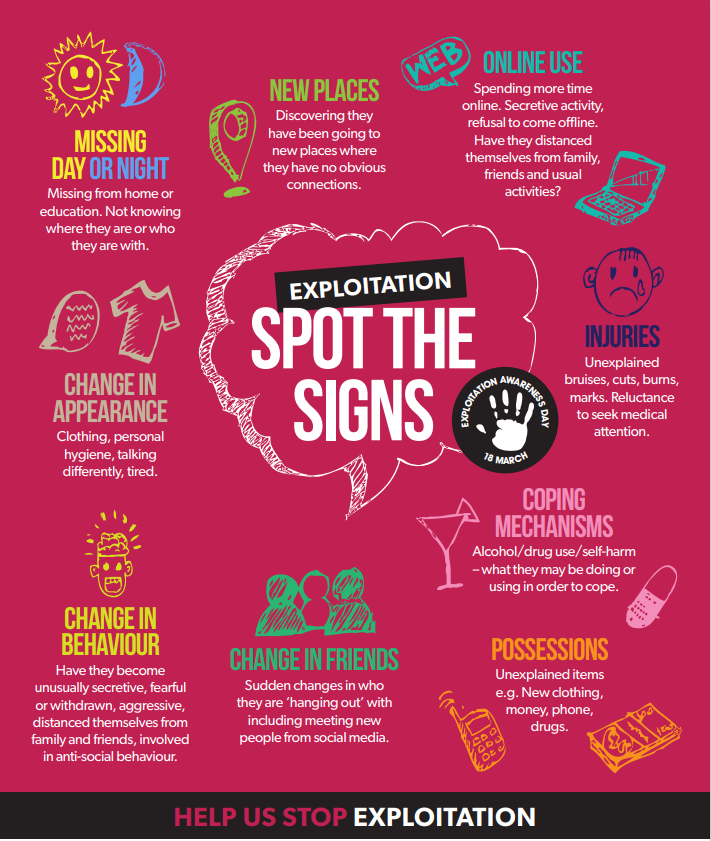
Signs of Grooming and Sexual Exploitation
Signs of child sexual exploitation include the child or young person:
- going missing for periods of time or regularly returning home late
- skipping school or being disruptive in class
- appearing with unexplained gifts or possessions that can’t be accounted for
- experiencing health problems that may indicate a sexually transmitted disease
- having mood swings and changes in temperament
- using drugs and/or alcohol
- displaying inappropriate sexualised behaviour, such as over-familiarity with strangers, dressing in a sexualised manner or sending sexualised images by mobile phone (“sexting”)
- they may also show signs of unexplained physical harm, such as bruising and cigarette burns.
Operation Encompass
As a school, we are participating in Operation Encompass. This means that we work with Avon and Somerset Police to safeguard and support our students and families, including receiving Police reports relating to domestic abuse. For more information, please visit the Operation Encompass website.
